







IMSCC Marks 20 Years of Global STEAM Education
20th International Mathematical Science Creativity Competition closes in success… 20 years of creative STEAM education shared with the world
Held October 30
- GURI--(Korea Newswire)
- 2026-11-04 16:13:12
- 1037


Marking its 20th anniversary this year, the competition was held as an international event under the theme ‘4Dframe × Embodied AI: Play, Create, Interact!’, sharing creative works and educational achievements that integrate mathematics, science, engineering, the arts and technology. Built on a network of 20 member countries, the event gave students, teachers, researchers and education professionals the opportunity to share the results of creative STEAM education and to broaden the possibilities for international cooperation.
This year, 230 teams advanced to the finals across 12 divisions, with participants ranging from young children to elementary, middle and high school students, university students and adults. Using 4Dframe, participants built physical structures that embody mathematical and scientific principles, and presented a wide range of creative works incorporating AI and robotics.
Education Leaders Present a Vision for the Future of Creative STEAM Education
At the International STEAM Teacher Awards ceremony on October 30, KNUE President Cha Woo-gyu stressed in his welcoming remarks that the advancement of creative STEAM education begins with the imagination and practice of teachers who nurture students’ curiosity and create new learning experiences in the classroom. He also expressed his hope that educators from many countries would share their experience and wisdom across borders and discover new possibilities for education.
In his congratulatory address, Yoon Gun-young, Superintendent of the Chungcheongbuk-do Office of Education, emphasized that in a rapidly changing era, what matters more than technology itself is a human-centered perspective and the ability to solve problems creatively. He added that international exchange among students and teachers of different languages and cultures will become a valuable educational asset for future generations.
Agus Setiabudi, Vice Rector of Universitas Pendidikan Indonesia, noted in his congratulatory remarks that as artificial intelligence is rapidly introduced into education, hands-on learning that links 4Dframe with AI can play an important role in developing students’ creativity and problem-solving skills.
At the opening ceremony of the main competition on October 31, FAS Chairman Shin Ki-hyun emphasized that over the past 20 years, IMSCC has grown beyond a domestic creativity contest into an international forum for STEAM education with participants from around the world. He noted that in the age of AI, the ability to identify future problems on one’s own and to create solutions by combining science, technology and creativity is especially important.
In his congratulatory address, Do Seong-hoon, Superintendent of the Incheon Metropolitan City Office of Education, conveyed the message that the more AI provides quick answers, the more important it becomes to discover new questions, to not fear failure, and to solve problems collaboratively.
Atip Latipulhayat, Vice Minister of Primary and Secondary Education of Indonesia, also sent congratulatory remarks, praising the educational value of a competition in which knowledge is built through play, creation and interaction. The remarks were read on his behalf by Amalia Fitria, Counsellor at the Embassy of the Republic of Indonesia in Korea.
230 Teams in 12 Divisions Turn Creative Ideas into Real Works
The finals on October 31 featured competitions in 12 divisions, including Play, Creativity, Maker, Invention and Capstone Design. Using 4Dframe, participants explored geometric structures and mathematical principles and presented a wide variety of works applying them to scientific inquiry and engineering design.
Creative ideas connected to everyday life drew particular attention, including an eco-friendly plant-growing system, a robot for delivering supplies at disaster sites, and inventions designed to solve everyday problems. Beyond the quality of their finished works, participants demonstrated the real value of STEAM education through an inquiry process of identifying problems and repeatedly designing, building, testing, and improving.
The competition was also significant in offering opportunities for creative challenge and international exchange to participants of all ages and educational backgrounds, including students in special education.
International STEAM Teacher Awards… Recognizing the Innovative Work of Educators Worldwide
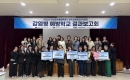
On October 30, the first day of the event, the ‘2026 International STEAM Teacher Awards’ ceremony was held at Cheongram Art Hall, KNUE.
The International STEAM Teacher Awards were established to recognize teachers who practice creative STEAM education connecting science, technology, engineering, the arts and mathematics in the classroom, and who have contributed to developing and researching innovative educational programs, mentoring students, and advancing international cooperation in education.
This year, seven teachers working in Korea, Indonesia, Hong Kong, Mongolia, Sweden, and other countries were selected as award recipients. The recipients shared the creative STEAM teaching experiences and achievements from their own classrooms, adding meaning to international cooperation in education.
International Conference and Student Forum… Discussing the Future of STEAM Education
An international conference and a student forum were also held during the event.
At the conference, research and teaching cases were presented on a wide range of topics, including STEAM practice in schools, multisensory and language-integrated learning, sustainability and STEAM education, mathematical structures and modeling, and community partnerships for expanding access to education.
In particular, a range of programs